 Skip to content
The cannabis landscape is shifting rapidly, moving far beyond simple flower to reveal the intricate chemistry that powers the plant’s effects. At the forefront of this evolution is the THCa concentrate, a product that has effectively captivated the attention of connoisseurs and medical researchers alike. For those navigating the vibrant streets of Washington DC, the search for purity and potency often leads directly to this crystalline powerhouse. However, you might wonder what exactly makes a THCa concentrate so special compared to traditional cannabis extracts?
Rather than just another method to achieve a high, THCa concentrate represents the raw, unrefined potential of the cannabis plant. In fact, it is the precursor to the experience you know and love, waiting for the right moment—and specifically the right temperature—to transform. As the market floods with new terms like “diamonds” and “sauce,” understanding the science and the art behind every THCa concentrate becomes essential. Therefore, this guide dives deep into the chemistry, the craft, and the consumption of these products, ensuring you have the knowledge to elevate your next session at Highthere.
What You’ll Discover in This Guide
- The Science: Understanding the precursor status of THCa.
- The Process: How extraction creates purity.
- The Products: From diamonds to rosin.
- The Method: How to consume responsibly.
The Rising Popularity of THCa Concentrate in the Cannabis Market
Interest in THCa concentrate products has exploded recently. This surge is largely driven by a consumer base that demands cleaner, stronger, and more flavorful options. For instance, Google Trends data indicates a significant spike in searches for terms like THCA Diamonds, Live Rosin, and THCa Badder over the last year, reflecting a nationwide shift toward high-purity cannabinoids. In Washington DC, this trend is particularly palpable. Consequently, enthusiasts are moving away from generic extracts and are instead seeking out specific terpene profiles and solventless processes that preserve the plant’s true essence.
What is THCa? The Non-Psychoactive Precursor
To truly understand the THCa concentrate, you must first understand the molecule itself. Tetrahydrocannabinolic acid (THCa) is the most abundant non-psychoactive cannabinoid found in raw, living cannabis plants. Contrary to popular belief, the live plant does not produce significant amounts of Delta 9 THC directly. Instead, it synthesizes carboxylic acids, primarily THCa and Cannabidiolic acid (CBDA).
Deciphering THCa: Tetrahydrocannabinolic Acid Explained
Chemically, THCa is the acidic form of THC. It exists naturally in the trichome heads of the plant—the tiny, crystal-like resin glands that coat the cannabis flower. However, in its raw form, THCa does not bind effectively to cannabinoid receptors CB1 and CB2 in the brain because of its molecular shape. Specifically, it contains an extra carboxyl group (COOH) that prevents it from fitting into the receptor site that triggers euphoria.
THCa vs. THC: A Crucial Distinction (Understanding the “A” in THCa)
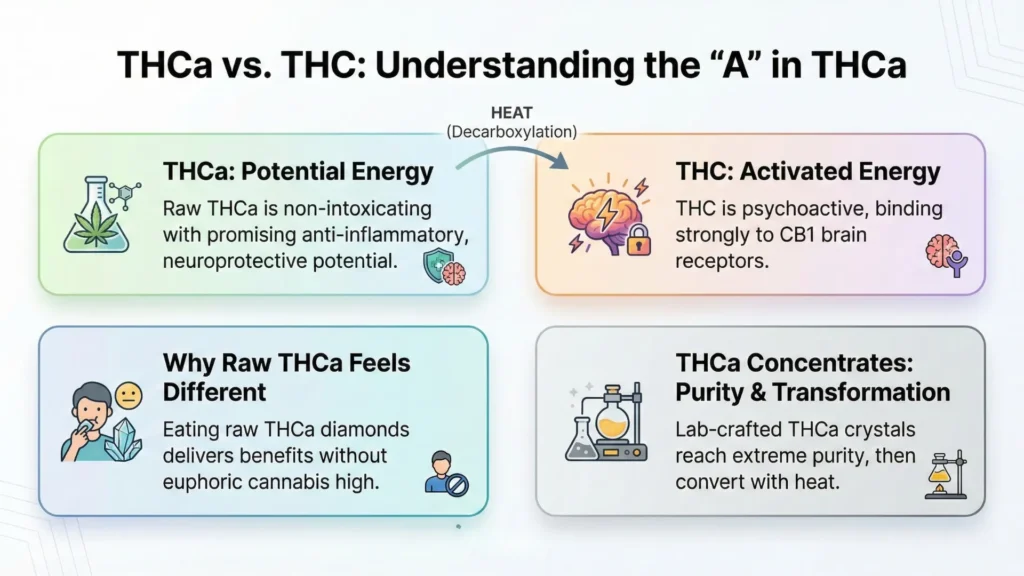
The difference between THCa vs. THC is essentially the difference between potential energy and kinetic energy.
- THCa (Tetrahydrocannabinolic acid): Non-intoxicating, anti-inflammatory potential, neuroprotective properties.
- THC (Delta 9 Tetrahydrocannabinol): Intoxicating, psychoactive, binds to CB1 receptors.
This distinction is vital for consumers. For example, if you were to eat raw THCa diamonds, you would likely not feel the “high” associated with traditional dabs. On the other hand, you would still be introducing a potent cannabinoid into your system, which interacts with the endocannabinoid system in other beneficial ways.
The Chemical Structure and Properties of Raw THCa Concentrate
Raw THCa is chemically unstable. Over time, or naturally with exposure to heat and light, it degrades into Delta 9 THC. However, in a controlled laboratory setting, this instability is managed to create stable THCA Concentrate forms like crystalline structures. These isolates can subsequently reach a purity level of 99%, making them some of the most potent products available at Highthere.
Why THCa is Not Psychoactive in its Natural State
The lack of psychoactivity stems primarily from the molecule’s size and shape. Because the extra carboxyl group makes the molecule larger, it is prevented from crossing the blood–brain barrier as efficiently as THC. Furthermore, this inhibits its ability to activate the cannabinoid receptor-1 (CB1). Consequently, this property allows medical patients to consume large doses of raw phytocannabinoids for therapeutic purposes without the side effect of intoxication, provided they keep the product cool.
The Magic of Decarboxylation: Activating THCa Concentrate for Effect
For those seeking the euphoric effects of cannabis, the THCa concentrate must undergo a physical transformation. This process is scientifically called decarboxylation.
How Heat Transforms THCa into Psychoactive THC
Decarboxylation is a chemical reaction that removes the carboxyl group from the THCa molecule. As a result, it releases carbon dioxide (CO2) and water vapor. This “decarbing” process instantly converts Tetrahydrocannabinolic acid into the psychotropic Δ (9)-tetrahydrocannabinol. Therefore, when you light a joint or hit a vaporizer, you are performing instant decarboxylation.
Understanding the Temperature and Time for Optimal Conversion
The conversion isn’t just about applying fire; rather, it requires specific heat management.
- Vaporizing: Temperatures between 315°F and 450°F effectively convert the THCa concentrate without destroying the delicate terpenes.
- Edibles: For incorporating THCa into edibles, the extract must be pre-decarboxylated in an oven, typically at around 240°F for 30-40 minutes.
Controlled Decarboxylation: Preserving Terpenes and Potency
If the heat is too high, you risk degrading the terpenes—the aromatic compounds responsible for the flavor profile and entourage effect. Moreover, high heat can degrade THC into CBN, a cannabinoid known for sedation. Modern dabbing techniques, such as cold-start dabs, prioritize lower temperatures. This approach maximizes the conversion of the THCa concentrate while retaining the natural terpenes found in high-quality Live Resin.
The Role of Decarboxylation in Consuming THCa Concentrate
When you purchase a THCa Concentrate Live Resin Crumble or THCa Diamonds from Highthere, you are buying a product that is mostly THCa. Consequently, the heat from your dabbing rig or vaporizer serves as the final manufacturing step. This ensures that the product remains shelf-stable and retains maximum potency until the very moment of consumption.
A Spectrum of Purity: Exploring Different THCa Concentrate Types
The world of concentrates is diverse. Depending on the extraction methods used, the final THCa concentrate can take many forms, each with unique textures and uses.
| Concentrate Type | Est. Potency (THCa) | Flavor Profile | Best Consumption Method |
|---|---|---|---|
| THCa Diamonds | 95% – 99% | Low (unless in Sauce) | Dabbing Rig |
| Live Rosin | 70% – 85% | Rich, True-to-Plant | Low-Temp Dab / E-Rig |
| Live Resin | 75% – 90% | Robust, Terpene-Heavy | Vaporizer / Dab |
| Badder / Budder | 70% – 90% | Creamy, Intense | Dabbing / Infusing |
THCa Crystalline (Diamonds): The Pinnacle of Purity
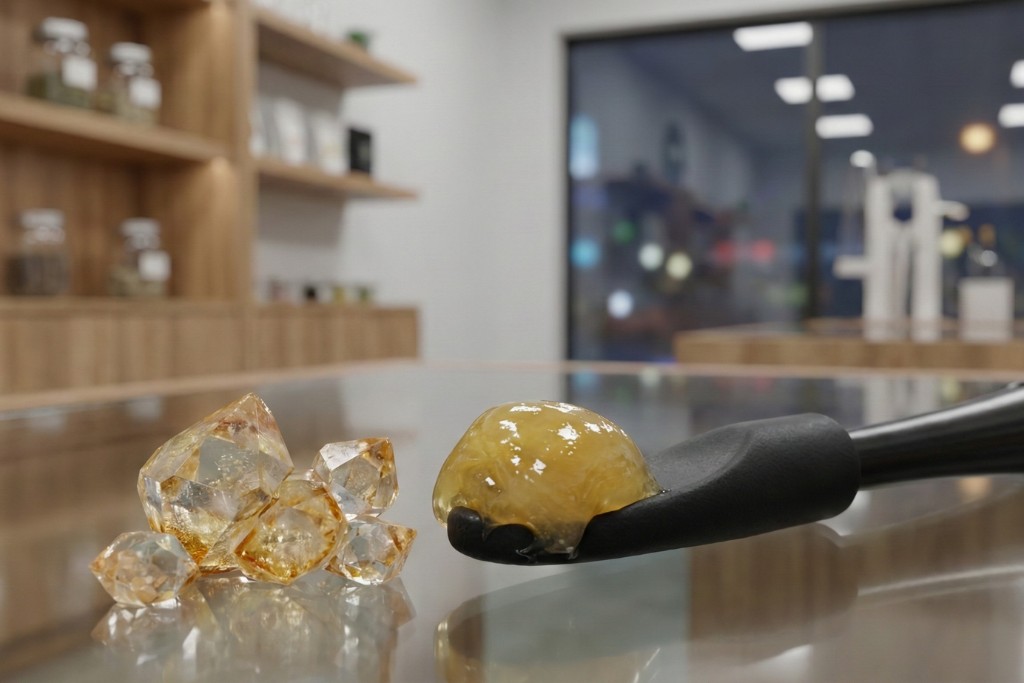
THCa Diamonds are effectively the crown jewels of cannabis extracts. These are solid, semi-transparent crystals that are nearly 100% pure THCa. They are formed by allowing the cannabinoid to crystallize out of a solvent solution under pressure. Because they are almost pure cannabinoid, they have very little flavor on their own. Therefore, they are often sold swimming in a “terp sauce” to add flavor and effect.
THCa Sauce: A Terpene-Rich Experience
Sauce is a high-terpene full-spectrum extract (HTFSE). It has a liquid, sticky consistency and is packed with high levels of terpenes and cannabinoids. Often, producers mix crystalline diamonds into this sauce. The result is a THCa concentrate that delivers the massive potency of diamonds with the complex terpene profiles of the original strain.
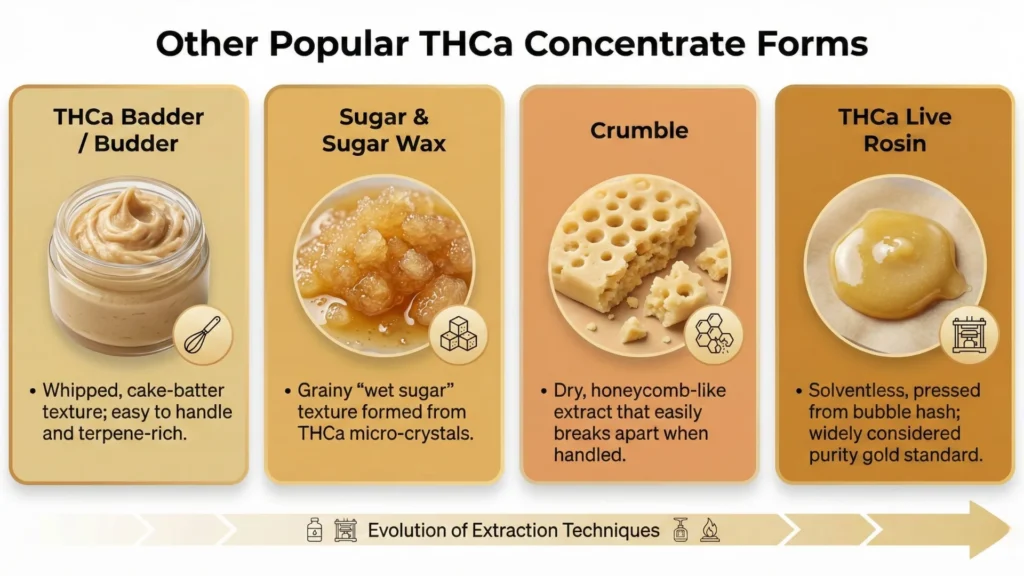
Other Popular THCa Concentrate Forms
- THCa Badder/Budder: A whipped THCa concentrate with a cake-batter consistency. It is easy to handle and rich in terpenes.
- Sugar and Sugar Wax: These have a grainy texture like wet sugar, formed when THCa creates micro-crystals during processing.
- Crumble: A drier, honeycomb-like extract that falls apart easily.
- THCa Live Rosin: A solventless extract made by pressing ice water extraction bubble hash. This is widely considered the gold standard for purity.
The “Why” Behind Specific Forms: Targeting Effects and Preferences
Choosing between a THCa Live Hash Rosin and THCa Distillate often comes down to preference.
- Flavor Chasers: Usually prefer Live Rosin or Sauce because the cold extraction or fresh-frozen processing preserves the flavor profile.
- Potency Seekers: Often gravitate toward Diamonds or THCa Isolate for the sheer strength.
- Convenience: Disposable Vapes and THCa Live Rosin Carts offer portability.
Why Choose a THCa Concentrate? Benefits and Unique Appeal
Why are consumers in DC switching from cannabis flower to a THCa concentrate? The answer lies primarily in the specific benefits offered by these potent products.
The Power of Raw THCa: Potential Non-Psychoactive Benefits
Emerging research suggests raw THCa has significant therapeutic potential. For instance, studies have looked at its role in modulating calcium signalling and mitochondrial calcium levels, which are crucial for cellular health. Furthermore, scientific literature explores THCa’s interaction with the immune system, suggesting it may inhibit the production of inflammatory proteins.
Leveraging Decarboxylated THCa Concentrate: High Potency and Targeted Effects
Once heated, THCa concentrates offer immediate and powerful relief. For patients with high tolerance or severe symptoms, the concentrated nature of these products (often 70-90% potency) is far more effective than flower (usually 15-30%). Therefore, a smaller amount is needed to achieve the desired effect.
Enhanced Flavor and Aroma: The Role of Terpenes in Concentrates
Concentrates like Live Resin utilize fresh-frozen plants, capturing the full-spectrum profile of the living plant. This preservation leads to a more robust entourage effect, where cannabinoids and terpenes work synergistically. For example, strains like Orange Tangie (citrusy/uplifting) or Purple Gas (earthy/relaxing) express their true characteristics vividly in concentrate form.
The Craft Behind the THCa Concentrate: How It Is Made
The journey from soil to oil involves sophisticated extraction techniques.
The Art of Extraction: Isolating THCa from Cannabis Plant Material
There are two main schools of thought in extraction: solvent-based and solventless.
- BHO Extraction (Butane Hash Oil): This method uses hydrocarbons to strip cannabinoids from the plant. It is efficient and creates products like Shatter and Live Resin.
- Solventless Process: In contrast, this method uses only ice, water, heat, and pressure. Ice water extraction separates the trichome-rich resin from the plant to make Bubble Hash, which is subsequently pressed into Hash Rosin.
The Purification Process: Achieving High THCa Percentages
To create THCa Isolate or Diamonds, technicians perform further purification on the raw extract. This often involves chromatography or “diamond mining.” During this process, the extract is left under pressure for weeks. Consequently, this allows the THCa molecules to stack into cannabis crystals while the terpenes separate into a liquid layer.
Quality Control and Testing: Ensuring Purity and Safety
Safety is paramount. Therefore, reputable products available at Highthere come with a Certificate of Analysis (COA). This document from a third-party laboratory verifies the potency and ensures the THCa concentrate is free from residual solvents, pesticides, and heavy metals. You should always check the lab testing results before purchasing.
Unlocking the Experience: How to Consume THCa Concentrate
Dabbing: The Most Popular Method for Instant Effects
Dabbing involves dropping a small amount of THCa concentrate onto a hot surface (a nail or banger) and inhaling the vapor.
- First, heat the dabbing rig nail.
- Next, let it cool to the desired temperature (low temp is better for flavor).
- Then, apply the THCa Badder or Rosin.
- Finally, inhale and cap the nail to control airflow.
Vaping THCa Concentrate Products: Convenience and Discretion
Portable devices like the THCA Disposable Vapes or THCa Live Rosin Carts are incredibly popular in DC. They contain liquid THCa concentrate (often decarboxylated slightly to flow) and offer a discreet way to consume on the go. Additionally, brands like WeedValley are often cited for high-quality input material for these vapes.
Incorporating THCa Concentrate into Edibles (Pre-Decarboxylation Required)
You can make your own edibles using THCa Crystalline. However, you must activate it first. Specifically, bake the crystals at 240°F until they stop bubbling (releasing CO2). Subsequently, dissolve the resulting oil into butter or coconut oil. This process allows for precise dosing in homemade treats.
Other Consumption Methods: Sprinkling on Flower or Adding to Joints
For a “turbocharged” experience, users often sprinkle THCa Snow Caps (flower coated in THCa powder) or Kief onto a bowl. Furthermore, you can place a snake of THCa Rosin inside a joint. This method, often called “twaxing,” adds a significant potency boost to standard Exotic THCA Flowers.
Navigating the Nuances of THCa Concentrate: Dosage and Safety
Responsible Consumption Practices for THCa Concentrates
Concentrates are incredibly potent. In fact, a piece the size of a grain of rice is often enough for an experienced user. Therefore, newcomers should start with even less. The mantra “start low and go slow” is critical to avoid overwhelming effects.
Potential Side Effects and How to Mitigate Them
High doses of THC can cause anxiety or paranoia. Interestingly, Cannabidiol (CBD) can help mitigate these effects. Consequently, keeping a CBD Concentrate or tincture on hand can help balance the high if it becomes too intense.
The Entourage Effect Revisited: Tailoring Your THCa Experience
The entourage effect posits that the sum of the plant’s parts is greater than the individual components.
- Hybrid strains like Cadillac Rainbow or Garlic Runtz offer balanced effects due to their complex terpene profiles.
- Indica-dominant profiles like Pre-98 Bubba Kush or Grandaddy Purple are preferred for relaxation.
- Sativa-dominant profiles like Sour Diesel or Sour Lemon Mac are chosen for energy.
By selecting a Full Melt Bubble Hash or Live Resin that retains these terpenes, you get a more nuanced experience than with pure THCa Distillate.
The Legal Landscape of THCa Concentrate: A Complex Picture
Federal vs. State Laws: The Nuances of Cannabis Legality
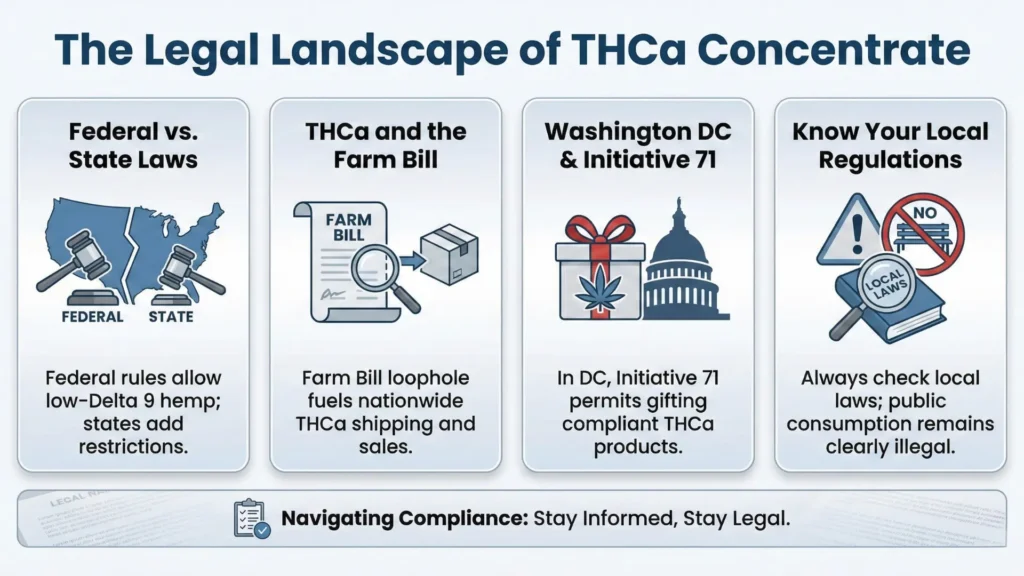
The legal status of THCa concentrate is a fascinating loophole. Under the 2018 Farm Bill, hemp derivatives containing less than 0.3% Delta 9 THC by dry weight are federally legal. Since THCa is chemically distinct from Delta 9 THC, many argue it falls under this protection, provided the raw product tests below that threshold.
THCa and the Farm Bill: Loopholes and Interpretations
This interpretation has subsequently led to a boom in THCA Hemp Flower Bags and concentrates shipping across the US. However, individual states have different regulations regarding THCa concentrate.
Varying Legal Status Across Different Jurisdictions
In Washington DC, the situation is unique. Initiative 71 (I-71) allows for the possession and gifting of cannabis. Shops like Highthere operate within this framework, providing high-quality THCa concentrates and THCA Sparks Prerolls as gifts or compliant purchases. It is crucial to purchase from compliant vendors who understand the local landscape.
Staying Informed: Resources for Understanding Local Regulations
Always rely on local resources. In DC, you can possess up to two ounces of cannabis. However, consumption is legally restricted to private property. Understanding these rules ensures a stress-free experience.
The Future of the THCa Concentrate Market: Research and Trends
Emerging Research on THCa’s Therapeutic Potential
Science is only scratching the surface. In fact, recent studies have investigated phytocannabinoids in the context of neurodegenerative diseases.
- Alzheimer’s Disease: Research has explored how cannabinoids might affect Aβ1–42 (amyloid beta) proteins and p-tau levels, which are markers for Alzheimer’s.
- Neuroprotection: There is interest in how cannabinoids interact with BDNF (Brain-Derived Neurotrophic Factor) in the hippocampus and N-methyl-D-aspartate receptors.
- Calcium Homeostasis: Studies on calcium dyshomeostasis and TRPV1 activation suggest cannabinoids may help regulate neural rhythms and protect the blood–brain barrier.
While these studies are often pre-clinical (in test tubes or animal models), they point to a future where specific cannabinoid receptor agonists could be used for targeted therapies.
Innovations in THCa Concentrate Production
The industry is seeing a shift toward “Cold Cure” techniques. Cold Cure Hash Rosin involves curing the rosin at low temperatures to create a wet, badder-like consistency that preserves volatile terpenes. Additionally, we are seeing “mechanically separated” diamonds, a solventless version of the popular THCa concentrate crystal.
The Growing Consumer Interest in Specific Cannabinoids
Consumers are becoming chemists. There is rising demand for minor cannabinoids blended with THCa concentrate, such as THCv for energy or CBN for sleep. Moreover, we are seeing a surge in specific exotic genetics like Compound Genetics strains (e.g., Apple Tarts, Grapes N Cream) appearing in concentrate form.
Predictions for the THCa Concentrate Market
Price points are stabilizing. Currently, in the US market, THCa concentrates can range from $20 to $80 per gram. In DC, prices at premium spots like Highthere reflect the quality of the starting material. Furthermore, we expect to see more solventless ice-water extraction products entering the market as consumers prioritize health and flavor over pure potency.
Conclusion: The Pure Potential of THCa Concentrate
From the raw cannabis extract to the glittering THCa Diamonds in your jar, the journey of this molecule is a testament to botanical science and human innovation. Whether you are seeking the profound relief of a heavy Black Lime dab or the uplifting creative spark of Banana Runtz rosin, a THCa concentrate offers a purity and intensity that flower alone cannot match.
For those in Washington DC, Highthere remains your trusted destination for navigating this crystalline world. By understanding the science of decarboxylation, the importance of terpene profiles, and the legal nuances of I-71, you are empowered to make informed choices that enhance your wellness and your lifestyle.
Elevate Your Experience with Highthere
Ready to unlock the full potential of the cannabis plant? Visit Highthere in Washington DC today. Our knowledgeable staff is here to guide you through our premium selection of THCa concentrates, ensuring you find the perfect match for your needs.
Frequently Asked Questions (FAQ)
Q: Is a THCa concentrate legal to buy in Washington DC?
A: Yes, under the Initiative 71 (I-71) framework, adults 21 and over can legally possess and be gifted cannabis products, including any THCa concentrate. Stores like Highthere operate in compliance with these local laws.
Q: Will using a THCa concentrate show up on a drug test?
A: Yes. Most standard drug tests look for THC metabolites. Since THCa converts to THC (and eventually to the metabolite THC-COOH) in your body after consumption, using a THCa concentrate will result in a positive test.
Q: What is the average price of a THCa concentrate in DC?
A: Prices vary based on quality and extraction method. Standard BHO extracts like wax or crumble typically range from $25 to $45 per gram. However, high-end solventless products like Live Hash Rosin or Diamonds generally range from $60 to $90+ per gram due to the labor-intensive production process.
Q: Can I eat THCa diamonds raw?
A: You can, but they will not get you high. Without heat (decarboxylation), THCa does not bind to the brain’s receptors to produce euphoria. However, some people consume raw THCa concentrate for its potential anti-inflammatory and neuroprotective benefits without the intoxication. Also, visit our partner dispensary for more options.